Art installation
Tech: openFrameworks · Python · Cura · Octoprint · wood-PLA 3D printing
Check the code here
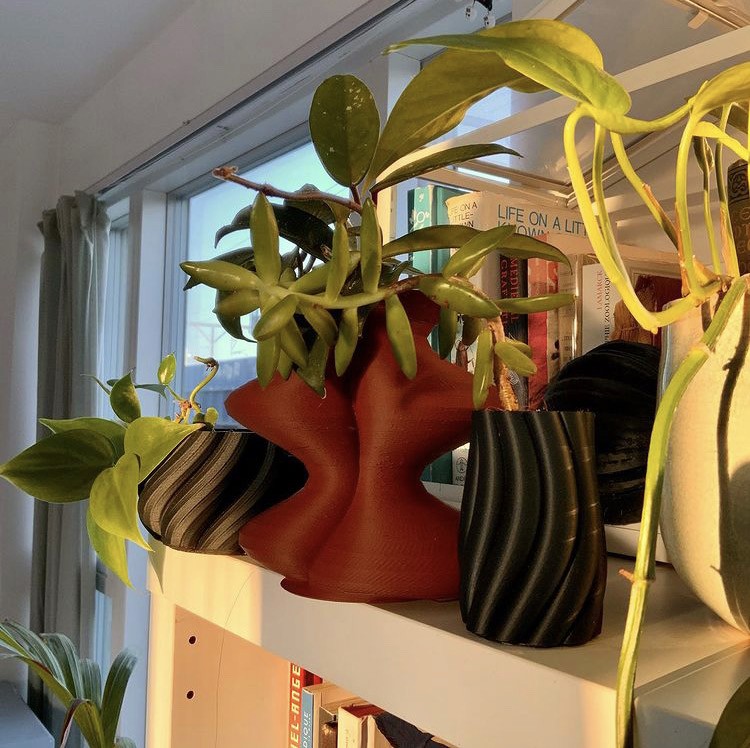
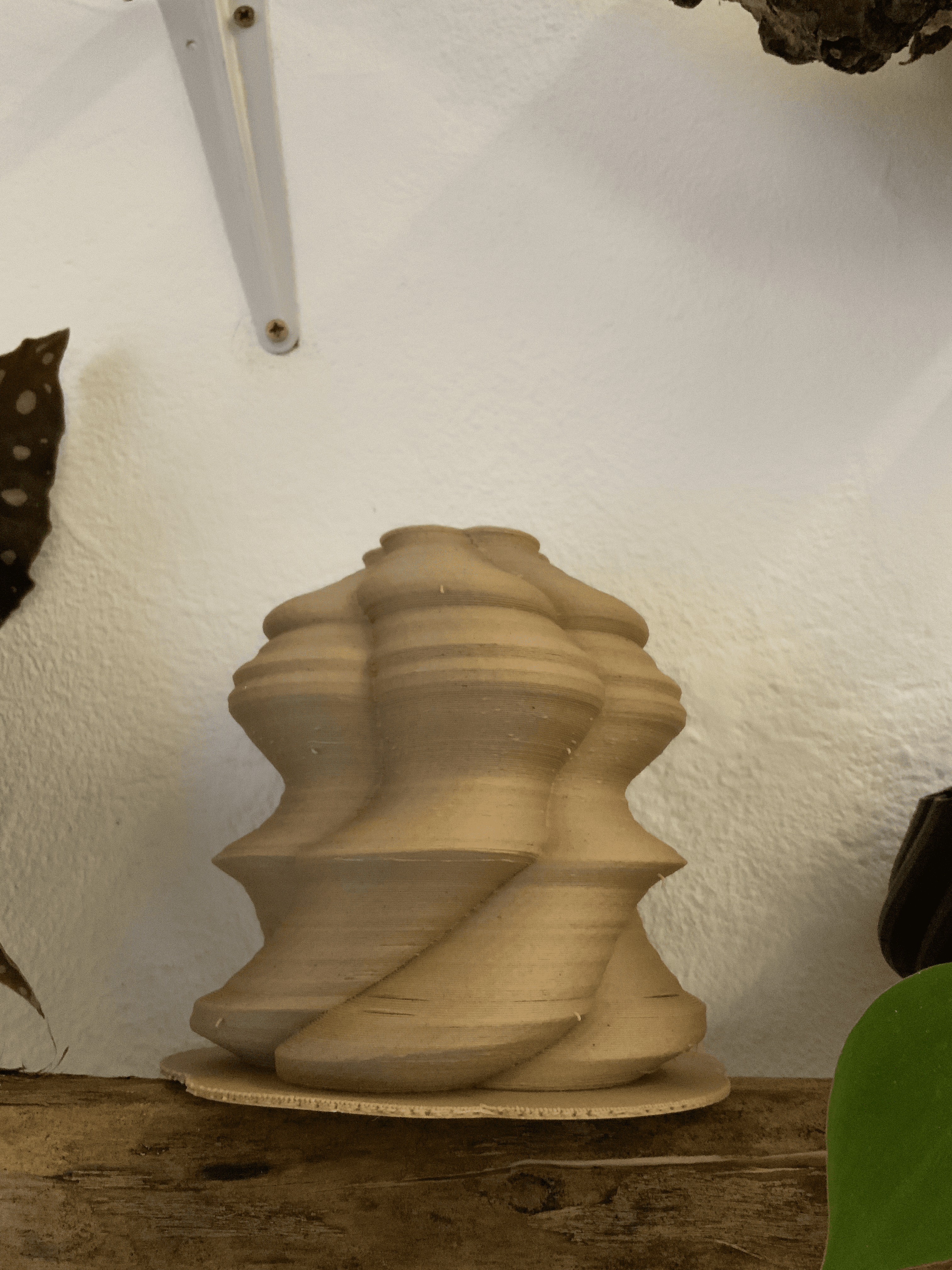
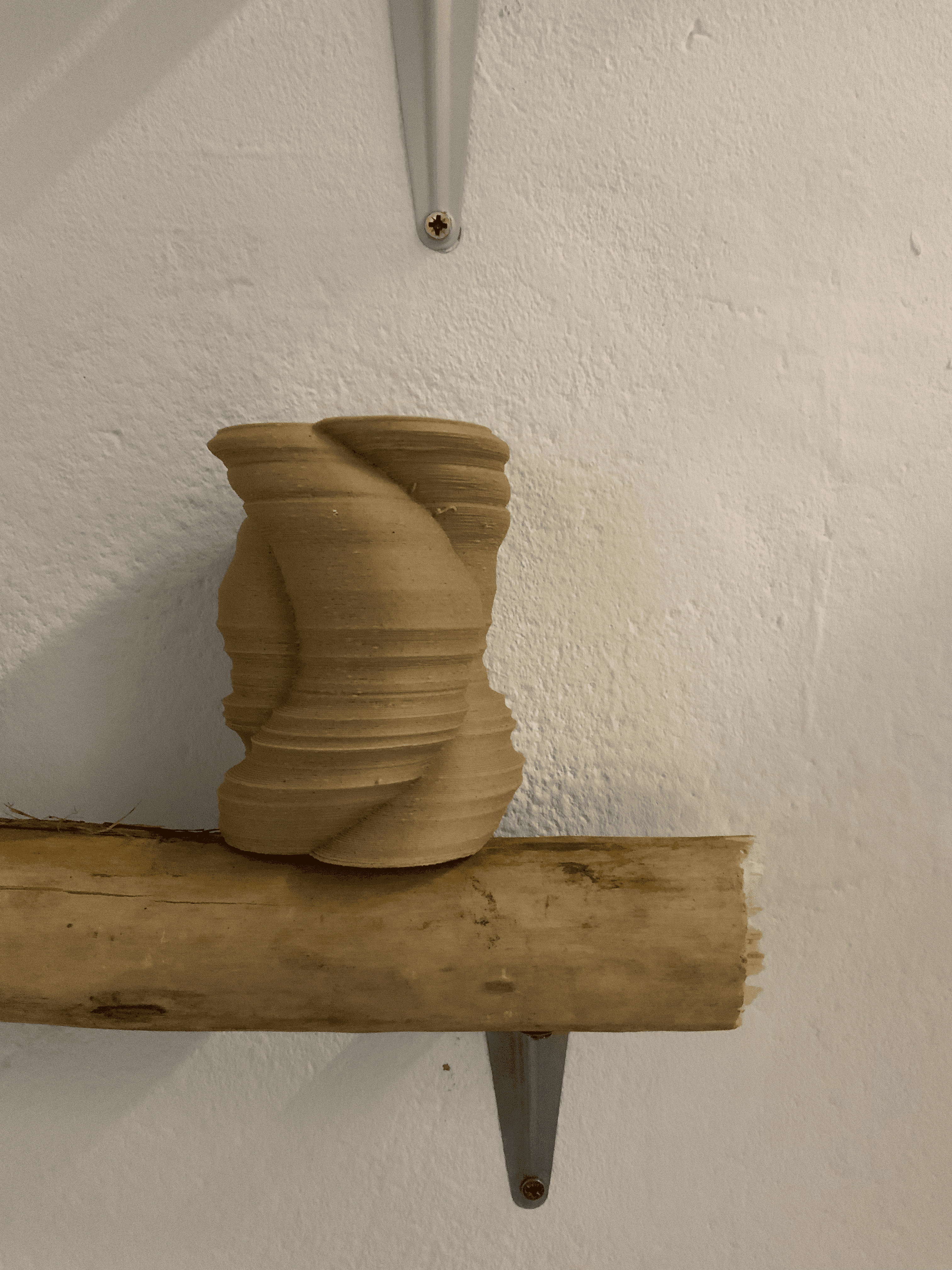
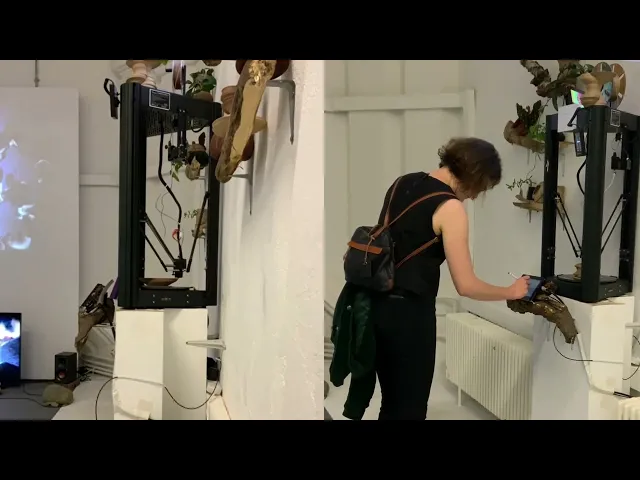
Holders is a collection of 3D containers generated from user's handwritings, and inspired by Le Guin's essay.
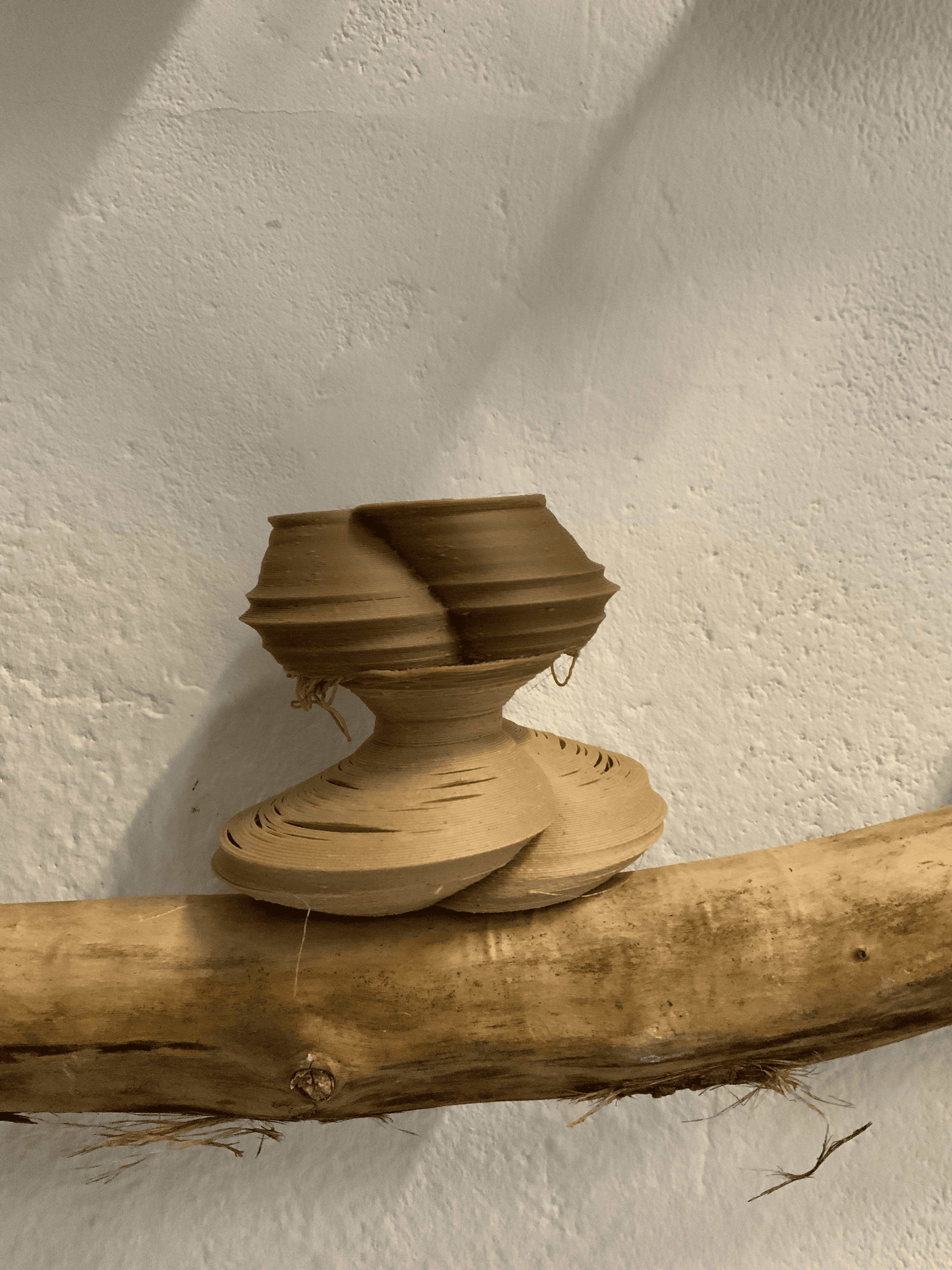
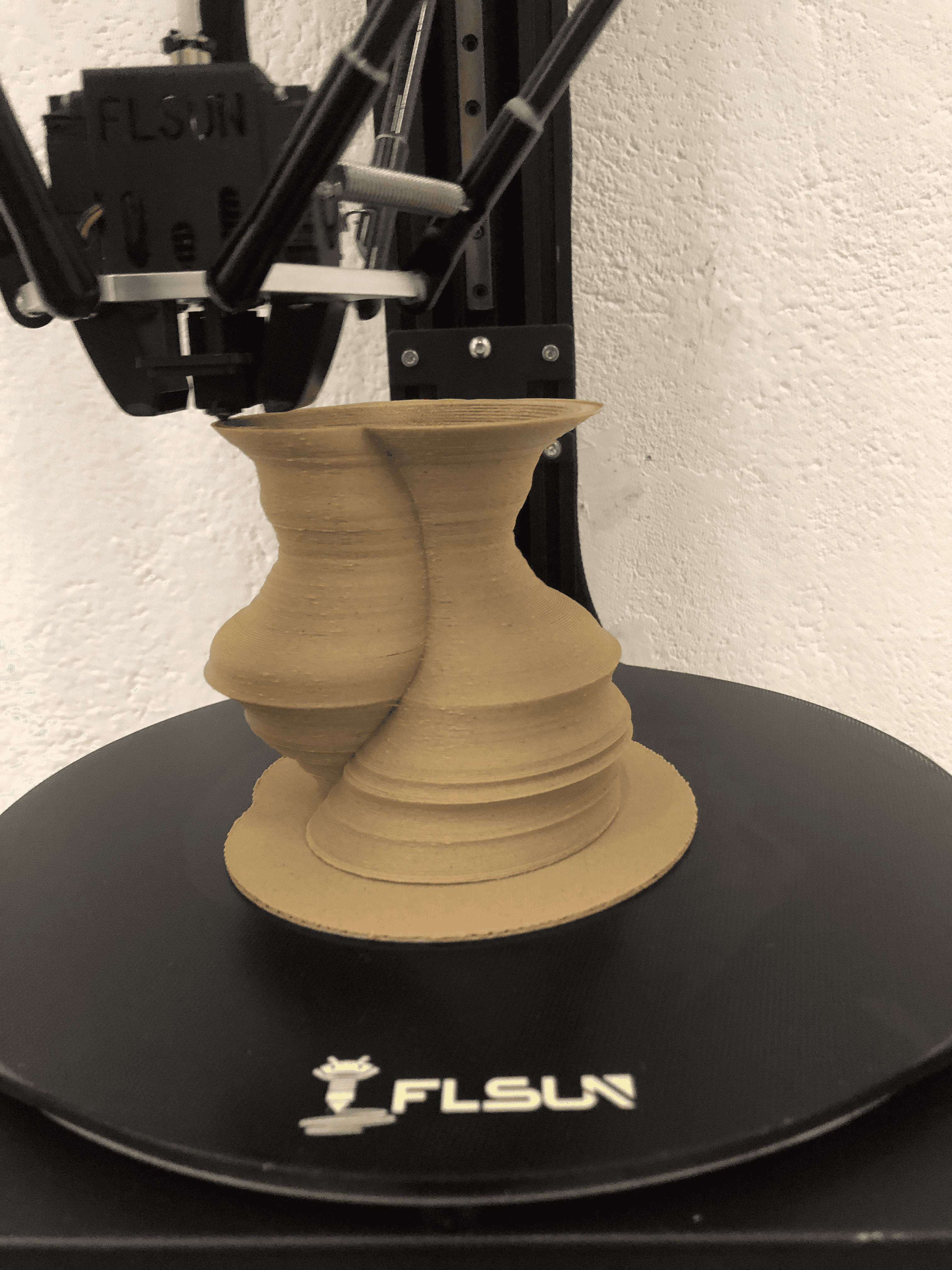
As individuals write and share stories or memories on the touch screen, new shapes are generated as pots, vases, containers. Recipients. Holders. The amalgamation of multiple stories creates ruptured or flowing shapes, made whole, and printed using wood filaments.
I initially wanted to create ceramic objects, generated from voices telling me about their lives and life stories, as a form of continuity and memorialisation. It had been a project of mine for years now, following the passing of my grandparents; a way to keep what small stories we cherished as humans, instead of the big stories that get us excited, that we curate for a crowd that doesn’t necessarily take interest in who we are at our cores. Grandparents were, to me, grandparents only - until I realised they had once been like me, with aspirations and dreams and stories of loss and laughter and heartbreaks and growth. But as time passed, I lost tracks of the initial project; too many elements got added, without much purpose apart from desperately trying to justify the shell of this idea I once had. As I sat reflecting on recent feedback, I got handed a tree seed by a stranger in the street. “Still there are seeds to be gathered, and room in the bag of stars.”, wrote Ursula K. Le Guin in The Carrier Bag Theory of Fiction. This essay, pocket sized, 7 pages or so, is one of my favourite books.
Something about the simplicity of what it states, and how it links the human experience to human stories to many things still, is incredibly comforting. I scraped most of the project, and reworked the rest to what came from my reflections on her text. “[...] but we have not heard about the thing to put things in, the container for the thing contained. That is a new story”. As I still wanted to create objects that held stories, any story, actual stories written or just the story of that one time someone came and interacted with my program, I decided to generate holder-shaped objects from handwritings. People can curate the stories they tell, but handwriting is a unique, culturally-relevant and intimate trait that we possess. These vases, pots, holders, are small enough to be carried home, and intriguing-looking enough to start conversations. They are made from stories, but rather than being finished, static objects, they convey new stories and start new interactions. Using the shape of the writing, instead of words, means there are no language restrictions. Visitors commented a lot on this, too - that they were happy they could write in hebrew, or in mandarin, or in cantonese, or any language and writing system, and still generate a holder to be printed. I wanted to create a slow corner for the exhibition, something interactive but with no immediate gratification. While frustrating to some, it was important to me to have people take their time writing, and then looking at the process, sometimes checking back at the end of the day. Storytelling is a slow art, and timing within it is important.
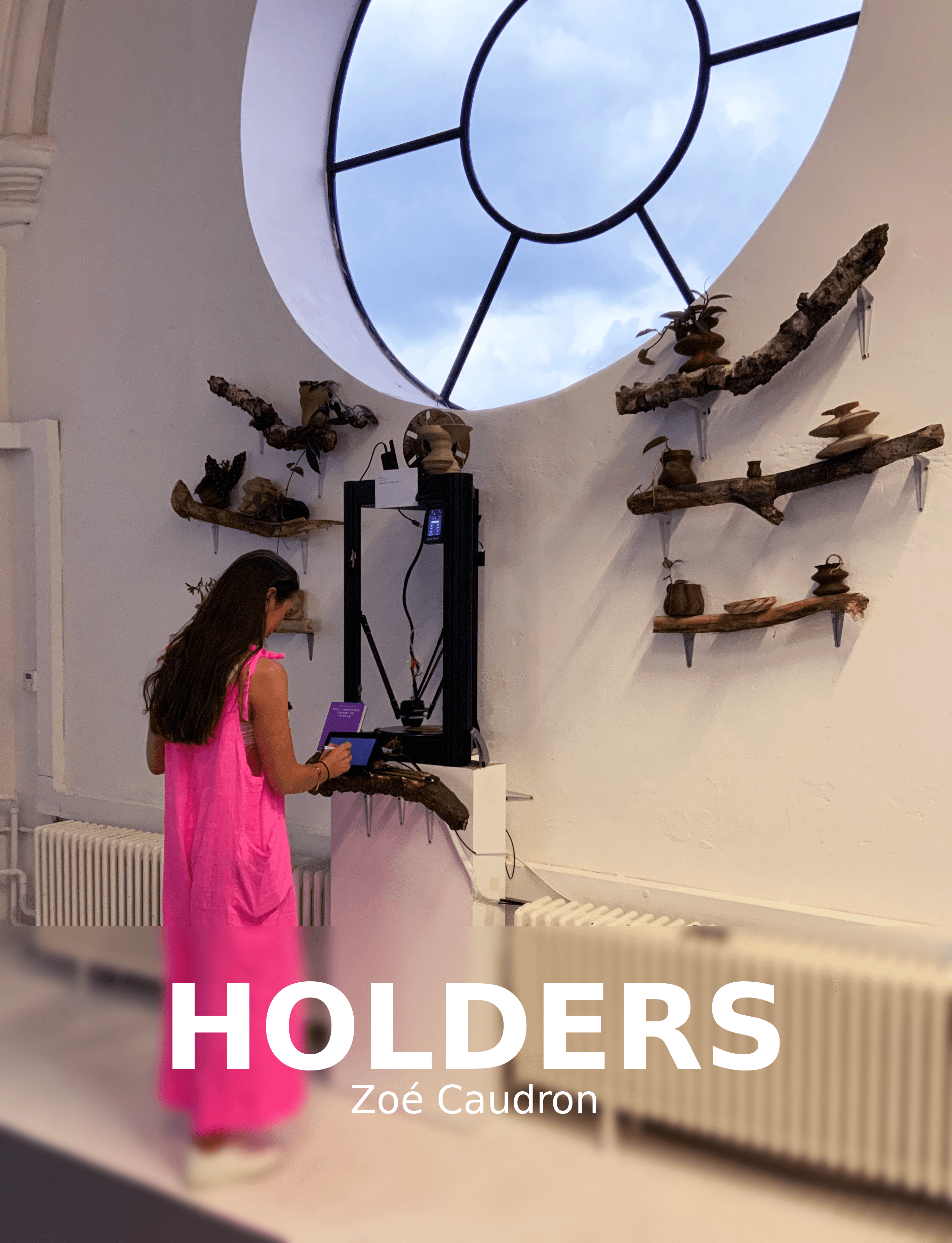
Any person who asked if they could take a holder home got to do so. I brought a few that I had printed beforehand, to make sure this could be done. By bringing home a holder, either theirs (generated in the morning or a day prior) or somebody else’s, they could carry on the storytelling. Knowing the story that made the holder is, in the grand scheme of things, unimportant. What matters is what stories will be attached to it from now on. Holders was not meant to be a political project, or a heroic take on society. I just wanted to create something beautiful, quiet, that would carry meaning to the onlookers, and that people would be happy to partake in. From the start, I wanted the installation to take very little space. Just a printer, a place for interactions to happen, and the results of previous days displayed around for all to see.
The use of logs, found in various parks, as shelves to showcase the holders complimented the space I was assigned, and tied back to the material used and the organic shapes.
TECHNICAL IMPLEMENTATION
I built a few extruders to try and print using homemade, sustainable materials, but their propensity to randomly burst out of the syringe in fantastic explosions made me renounce. I opted instead for wood PLA, a relatively sustainable material with interesting behaviours. As per the original concept I had, I thought about using voices to modify the meshes. Given the current context and the still-ongoing pandemic, I quickly changed this part of the concept and investigated other options. Handwritings did make more sense with the new idea, and was also safer. I also decided to incorporate sine-and-cosine-based-shapes, as they fascinate me and are at the core of many of my projects. I explored a few different sets of shapes that could all be generated from one parametric equation, with varying variables giving very different shapes.
I decided to go with cardioids, as I felt they worked best with what I wanted to create. I did however also get interesting results, reminiscent of a strange mathematical slug, that I might try and explore in further iterations of the project. The project would go as follow:
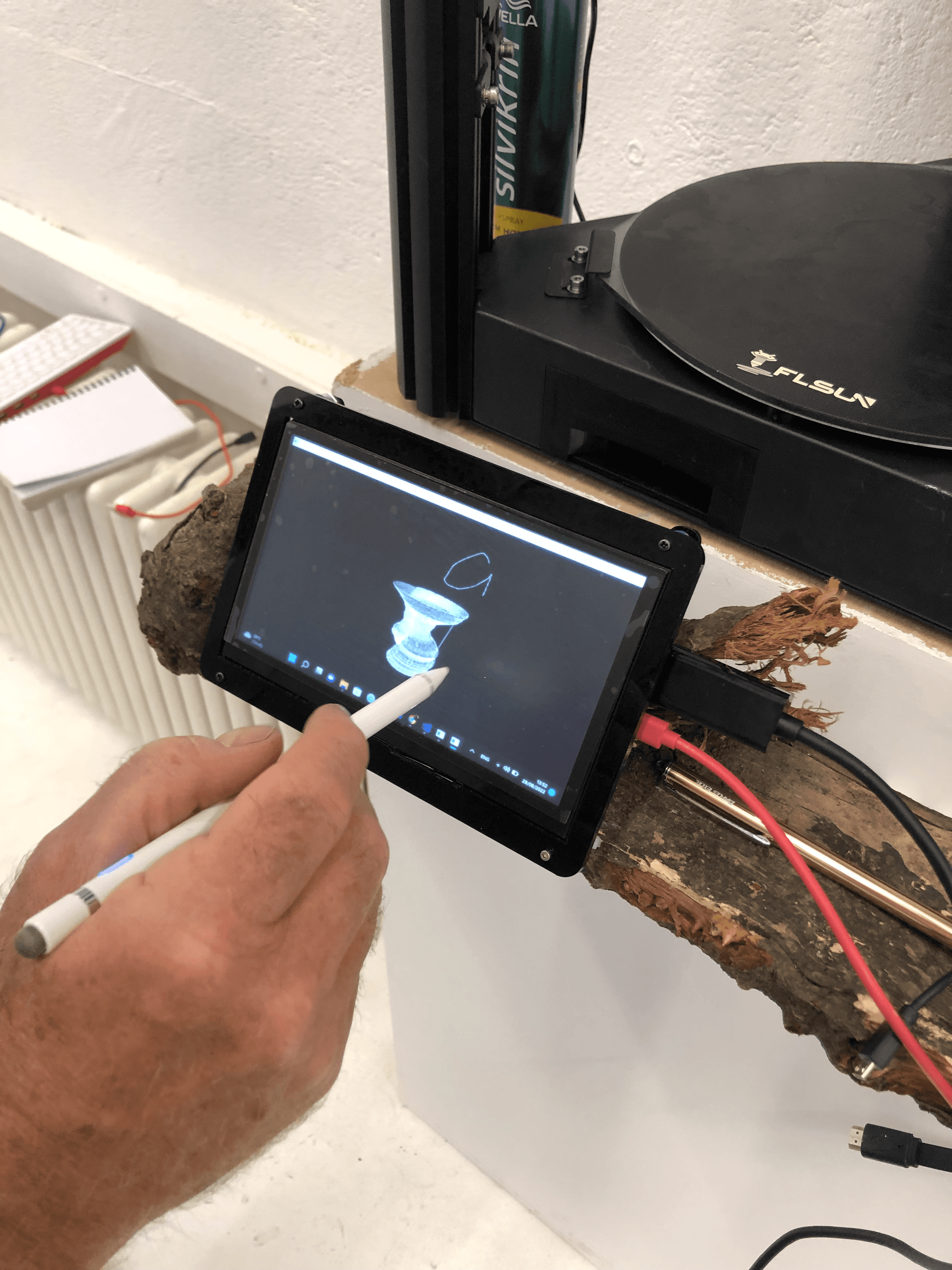
- An openFrameworks program runs on a touchscreen. Writing or drawing on the screen adds edges to a mesh, appearing on the screen to keep people engaged.
- The number of arcs and petals of the shape is decided based on the system time, as most human stories happen through a timeline imposed by external factors.
- If the interaction stops for a while, it is assumed that a new person will be writing the next interaction.
- If the holder reaches a certain size, or if a certain number of users have added to it, or if enough time has passed without any interaction, the mesh will be saved.
- The mesh is then sent to Cura by a Python program, sliced, and (depending on the state of the wifi) either directly uploaded to the printer’s SD card, or sent to Octoprint.
- Depending on the wifi, again, the print will either be queued or started via Octoprint, or manually started.
- As wood PLA reacts to temperature and humidity more than normal PLA, the prints would show a number of unique imperfections, or break off mid-printing. This adds another interesting external influence.
The program consists of a few randomised variables, variables tied to the system time, and user’s inputs. The handwriting is checked in the 2D space that is the touchscreen, with the mouse coordinates mapped to variables that will impact the shape of the holder. Getting the program to run fullscreen, on a touchscreen, required a few adjustments. I modified some of the examples in the “input/output” ofx folder. I also put a few different touch pens to be used. Depending on whether people used their fingers, a precision pen, or a glitchy pen, the experience and the shapes generated would be very different, offering then again an external factor influencing the end results. The generating-and-saving process is quite slow, and the printing process even more so. Each holder took between 3 and 9 hours to be made. Some had multiple colours, as the filament ran out mid-print. Some were incomplete, as some people figured out how to cancel a print using the printer’s touchpad. My focus wasn’t on having perfect objects, but interesting ones.
REFLEXION AND FUTURE DEVELOPMENT
As Marvin Minsky said, “Evidently, there is scarcely anything that one can say about a “single sensation” by itself, but we can often say much more when we make comparisons”. Seeing the holders printed during the exhibition, compared to the ones I had made at home, was a wonderful thing.
On opening night, I quickly realised that people didn’t really know if they could interact with the screen or not, even with a writing at the top suggesting they add a story. I changed the program that evening to invite them to pick up a pen, and made the process a little clearer, which did make a huge difference in the interactions and the length of the interactions.
The project spoke to both maths/computing oriented people and visual artists alike, which felt great. It also means I could adapt how I presented the project to what my interlocutor resonated with.
Some people did seem disappointed their interactions would not change the printing in real time, but would generally be happy to hear that what they had created would be printed as a single, stand-alone version they could collect.
In a computational arts space, the installation didn’t maybe offer enough compelling interactions to be as attractive as other projects. In hindsight, I could have found a way to keep some movement other than the head of the printer, as many people took photos of the installation from a distance, but didn’t come closer to interact with the project.
Other than this, I would like to keep working on this piece. Something I’m planning to explore is various ways to print with biomaterials, to then grow a variety of organic life forms onto the holders, cycling back to sustainability, but also creating an ever-changing shape, with a very limited existence in our time.
Another aspect I would like to explore is the impact, visual and conceptual, of scale. What if these were gigantic urns, instead of humble receptacles? Could they be made interactively, occupying a large space, with visitors being able to interact and therefore change different aspects of the process? Could they be made of ceramics, unfired but containing seeds that could sprout, or fired but with an interactive or generative way to apprehend the bisque firing, glazing, firing ritual of traditional potters?
I have started contacting artists, ceramists and people creating bio-materials, so I hope to have more answers soon.
REFERENCES
Le Guin, U. K., Yi, P., & Haraway, D. J. (2019). The carrier bag theory of fiction. Ignota.
Math curves from https://mathshistory.st-andrews.ac.uk and Joseph Choma’s book “Morphing”.
CODE REFERENCES
openFrameworks example folder on windowing: https://github.com/openframeworks/openFrameworks/tree/master/examples/windowing
ofBook, code adapted from their drawing program project: https://openframeworks.cc/ofBook/chapters/lines.html
Mastering openFrameworks, by Denis Perevalov. Chapter 7, Twisting Knot example.
Lewis Lepton’s tutorial on drawing: https://www.youtube.com/watch?v=xAqVb7qhqVE&list=PL4neAtv21WOlqpDzGqbGM_WN2hc5ZaVv7&ind ex=27